Diamond Engagement Rings
 Sapphire Engagement Rings
 Emerald Engagement Rings
 Ruby Engagement Rings
 Rings
Rings
 Earrings
 Necklaces
 Brooches
 Bracelets & Bangles
 Cufflinks
 Pendants
 Chains
 Tie Pins
 Lockets
 Charms
 Signet Rings
 Seals
Seals
 Curiosities
 UK / £
 USA / $
 AU / $


 Experts since 1975

-
Your Shopping Bag is empty

 Free Worldwide Delivery
 View All
 Diamond
 Sapphire
 Emerald
 Ruby
Ruby






Antique Jewellery Hallmarks: How to Read Them
A hallmark is a tiny set of stamps that can tell you what a piece is made of, where it was tested, who made it and, often, the year. Britain has the oldest system of consumer protection in the world, and for anyone buying antique jewellery, learning to read it is one of the most useful skills there is. It is also one of the first things we look at when a piece comes through the door.
What a hallmark is
A hallmark is not a maker’s stamp or a manufacturer’s logo. It is a guarantee, applied by an independent assay office after testing, that the metal meets a legal standard of purity. The name comes from Goldsmiths’ Hall in London, where marking has taken place for centuries.

A very short history
In 1300 Edward I required silver to meet the sterling standard and to be marked with a leopard’s head. Makers’ marks followed in the fourteenth century, and in 1478 London introduced a date letter, changed each year, so that the officials responsible for a piece could be traced. The lion passant, the mark for sterling silver, was added in 1544. For a short period from 1697 to 1720, a higher silver standard, Britannia, was compulsory, with its own marks.
Gold followed its own path. For centuries the standard was 22 carat; 18 carat was added in 1798, and in 1854 three lower standards, 15, 12 and 9 carat, were introduced. In 1932, 15 and 12 carat were abolished and replaced by 14 carat, which is why a 15ct mark is such a useful sign of an antique piece. You can read more in our guide to gold carats.
The marks and what they tell you
The sponsor’s or maker’s mark. Usually initials in a shaped shield, identifying the maker or the firm that sent the piece for assay. It is how we know, for example, that a ring was made by Charles Green & Sons.
The standard mark. The purity: the lion passant for sterling silver, and for gold a crown with a carat number, or later a number in parts per thousand such as 375, 585, 750 or 916.
The assay office mark. Where the piece was tested, shown below.
The date letter. A letter in a particular style and shield shape, identifying the year of assay. Until 1975 the letter changed partway through the year, so experts often give a two-year date. Since 1999 it has been optional.
The duty mark. Between 1784 and 1890, a profile of the reigning monarch showed that tax had been paid.
The assay offices
Each office had its own mark. London used the leopard’s head, crowned until 1821 and uncrowned afterwards. Birmingham uses an anchor and Sheffield a crown, replaced by a rose in 1975. Chester, which closed in 1962, used a sword between three wheatsheaves; Edinburgh a castle; Glasgow a tree, bird, bell and fish; and Dublin the figure of Hibernia with a crowned harp. Marks from long-closed offices such as York and Exeter are prized for their rarity.

The assay office marks









Matt: emphasise how you have different assay offices, maker’s marks and metal hallmarks
Marks from abroad
Other countries have their own systems. French gold is marked with an eagle’s head for 18 carat, and French silver with a boar’s head or Minerva. Much European jewellery is marked only with a number, such as 750 or 585. American jewellery was never hallmarked by an independent office: marks such as “14K” or “18K” are the maker’s own statement, not a guarantee.

When there is no hallmark
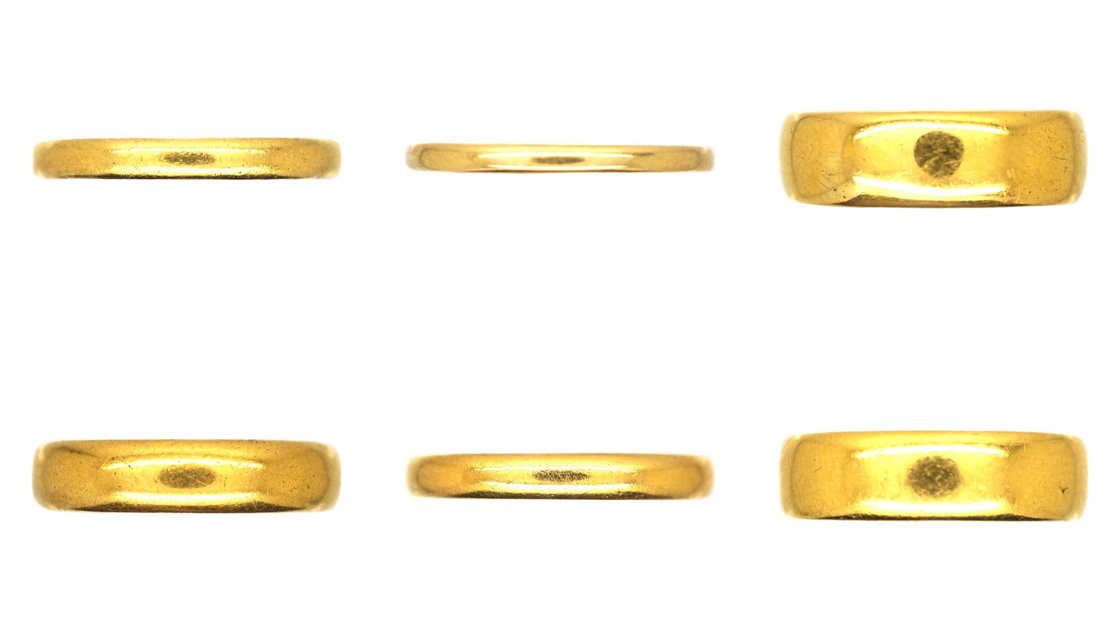
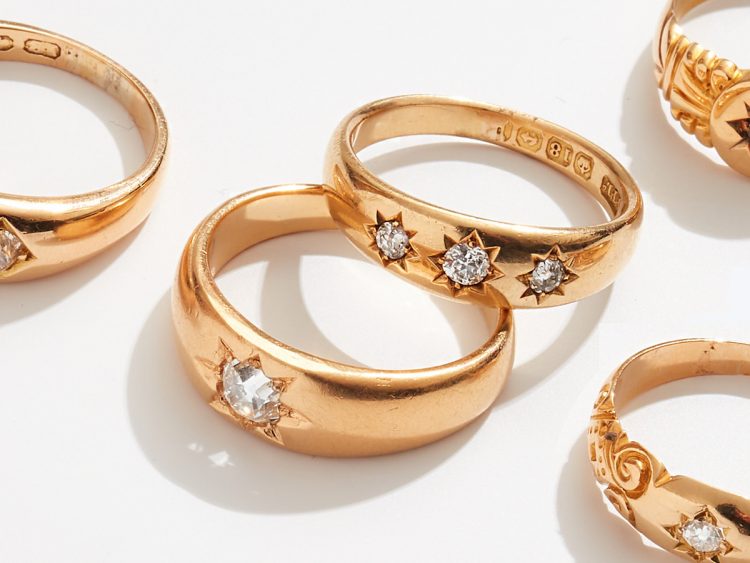
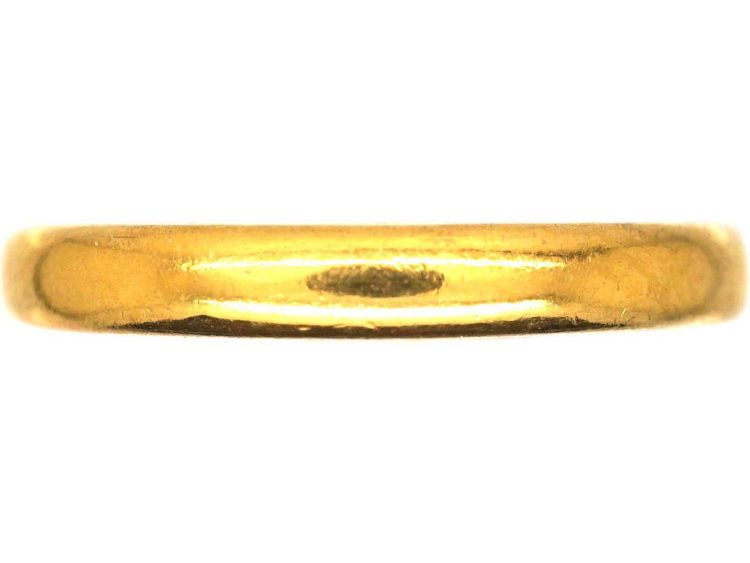
A missing hallmark is not in itself a warning sign. For most of history, a great deal of jewellery was exempt from hallmarking: small items, and pieces set with stones or too delicate to be marked, were often never sent for assay. Many of the finest Georgian and Victorian jewels are completely unmarked. Gold wedding rings are an exception, and were routinely hallmarked, which is why an antique wedding band can so often be dated to the year.
The first thing I do with any piece is turn it over. The back tells you far more than the front, and the marks, or the lack of them, are where the story starts.
Olly Gerrish, AJC Founder
What we look for
We read the full set of marks together: they should be consistent with each other and with the style of the piece. A modern standard mark on a supposedly Georgian ring, or a date letter that doesn’t match the design, needs explaining. We also look for marks that have been let in from another piece, a practice used to deceive, and for marks worn so thin they can no longer be read. Where a piece is unmarked, we test the metal and judge it on its construction.
Our view
Hallmarks are one of the great pleasures of British jewellery: a few millimetres of metal that can tell you a piece’s whole history. They are a guide, not a guarantee of age or quality, but read properly they are invaluable. A loupe and a pocket guide to date letters are the two best investments a collector can make.
If you would like a piece in our collection dated to a particular year, perhaps a wedding ring assayed in the year of a birth or marriage, just ask. It is one of our favourite requests.