Diamond Engagement Rings
 Sapphire Engagement Rings
 Emerald Engagement Rings
 Ruby Engagement Rings
 Rings
Rings
 Earrings
 Necklaces
 Brooches
 Bracelets & Bangles
 Cufflinks
 Pendants
 Chains
 Tie Pins
 Lockets
 Charms
 Signet Rings
 Seals
Seals
 Curiosities
 UK / £
 USA / $
 AU / $


 Experts since 1975

-
Your Shopping Bag is empty

 Free Worldwide Delivery
 View All
 Diamond
 Sapphire
 Emerald
 Ruby
Ruby





9ct, 15ct and 18ct Gold: What Gold Carats Mean
you've probably come across the phrase 24k, whether in Bruno mars' hit song or as the ransom in a James Bond film- but what does gold karat actual mean? Here's the answer.
9ct, 15ct, 18ct, 22ct: the carat number stamped inside a piece of gold jewellery tells you how much of it is pure gold. It affects the colour, the durability and the value, and in antique jewellery it can even help to date a piece. Here is what the numbers mean, and which we recommend for jewellery you will wear every day.
What a carat of gold means
Gold purity is measured in parts of 24. Pure gold is 24 carat; 18 carat is 18 parts gold to 6 parts other metals, or 75% gold. The other metals, usually silver and copper, make the gold harder and change its colour: more copper gives a warmer, rosier gold, more silver a paler one, and white gold is alloyed with metals such as palladium or nickel.
Modern hallmarks often show purity in parts per thousand, so you will also see 375 (9ct), 585 (14ct), 750 (18ct) and 916 (22ct). (In the United States the word is spelled “karat”, to distinguish it from the carat used to weigh diamonds.)
The standards and when they were used
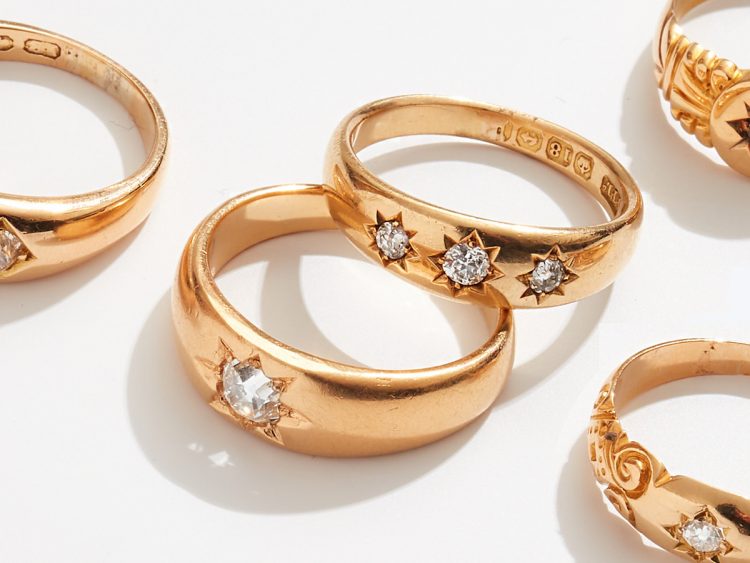
22 carat (91.6% gold) is rich, deep yellow and soft. For centuries it was the British standard, and it remained popular for wedding rings well into the twentieth century, like this wide 22ct wedding ring.
18 carat (75%) became a legal standard in Britain in 1798 and is the classic gold for fine jewellery: a warm colour, and hard enough for rings worn every day.
15 carat (62.5%) is the great Victorian and Edwardian gold. Introduced in 1854 and abolished in 1932, it is almost a signature of antique British jewellery, with a beautiful soft colour. We have a whole collection of 15ct gold engagement rings.
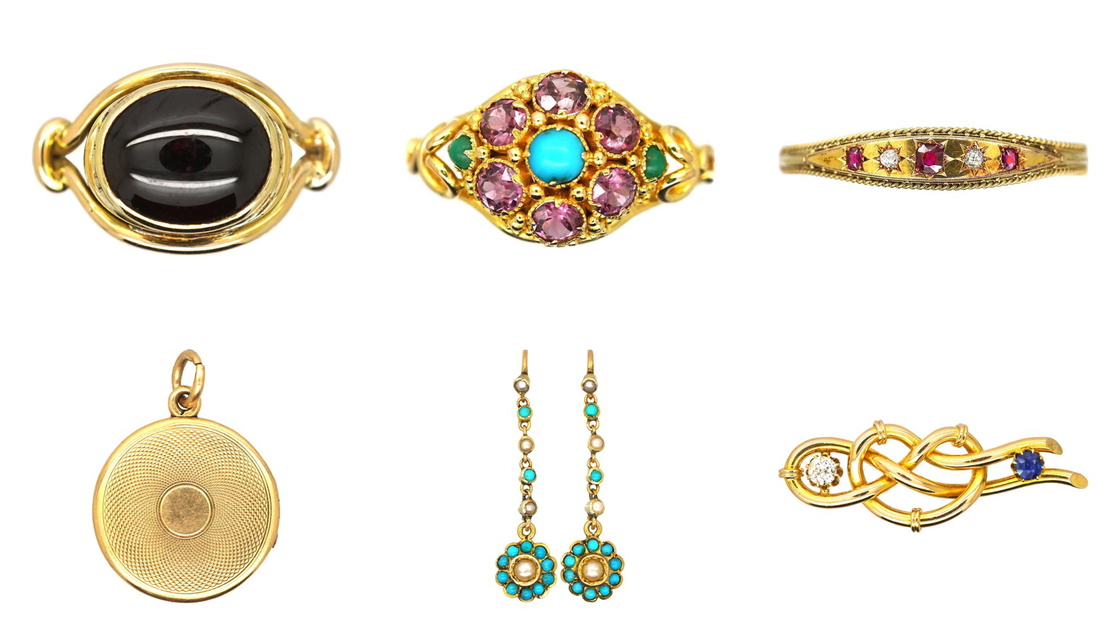
14 carat (58.5%) replaced 15ct in Britain in 1932, and is widely used in America and continental Europe.
9 carat (37.5%), also introduced in 1854, made gold affordable for a much wider public. It is durable and often has a lovely rosy tone, which is why so many Victorian chains and lockets are 9ct.
What a higher carat means
More gold means a richer colour and a higher intrinsic value, but also a softer metal. 22ct scratches and wears more quickly, which is why old 22ct wedding rings are so often worn thin and smooth. That softness is part of their charm, but it is worth knowing.
What a lower carat means
Lower-carat gold is harder and more resistant to scratches and knocks, and less expensive. It can be slightly paler or rosier in colour, and on the skin of some wearers very low carat gold can discolour a little over time. None of this makes it less desirable in antique jewellery: some of our favourite Victorian pieces are in 9ct gold.
Which is best for everyday wear?
For an engagement ring or anything worn daily, we recommend 18ct or 15ct gold, or platinum. Both golds have a beautiful colour and wear well for decades; 15ct has the added appeal of being almost exclusively antique. For a wedding band that you want to wear smooth over a lifetime, 22ct is hard to beat, as long as you accept that it will show its age gracefully.
I have a real soft spot for 15ct. It has a warmth you simply don’t see in modern gold, and it tells you straight away that a piece was made before 1932.
Olly Gerrish, AJC Founder
How to tell what you have
British gold is hallmarked with its carat, and the other marks can tell you where and when it was tested; our guide to reading antique hallmarks explains how. Much antique jewellery was never hallmarked, however, so if a piece is unmarked, a jeweller can test the gold for you. We are always happy to look at a piece at the Townhouse.
More guides
For more on choosing antique jewellery, see our guides to antique diamond cuts and ring sizing, and browse our 18ct gold engagement rings.