Diamond Engagement Rings
 Sapphire Engagement Rings
 Emerald Engagement Rings
 Ruby Engagement Rings
 Rings
Rings
 Earrings
 Necklaces
 Brooches
 Bracelets & Bangles
 Cufflinks
 Pendants
 Chains
 Tie Pins
 Lockets
 Charms
 Signet Rings
 Seals
Seals
 Curiosities
 UK / £
 USA / $
 AU / $


 Experts since 1975

-
Your Shopping Bag is empty

 Free Worldwide Delivery
 View All
 Diamond
 Sapphire
 Emerald
 Ruby
Ruby





Antique Baguette-Cut Diamonds: A Guide
Forget the bread, "diamonds" is what you'll think of once you hear baguette after reading this guide.
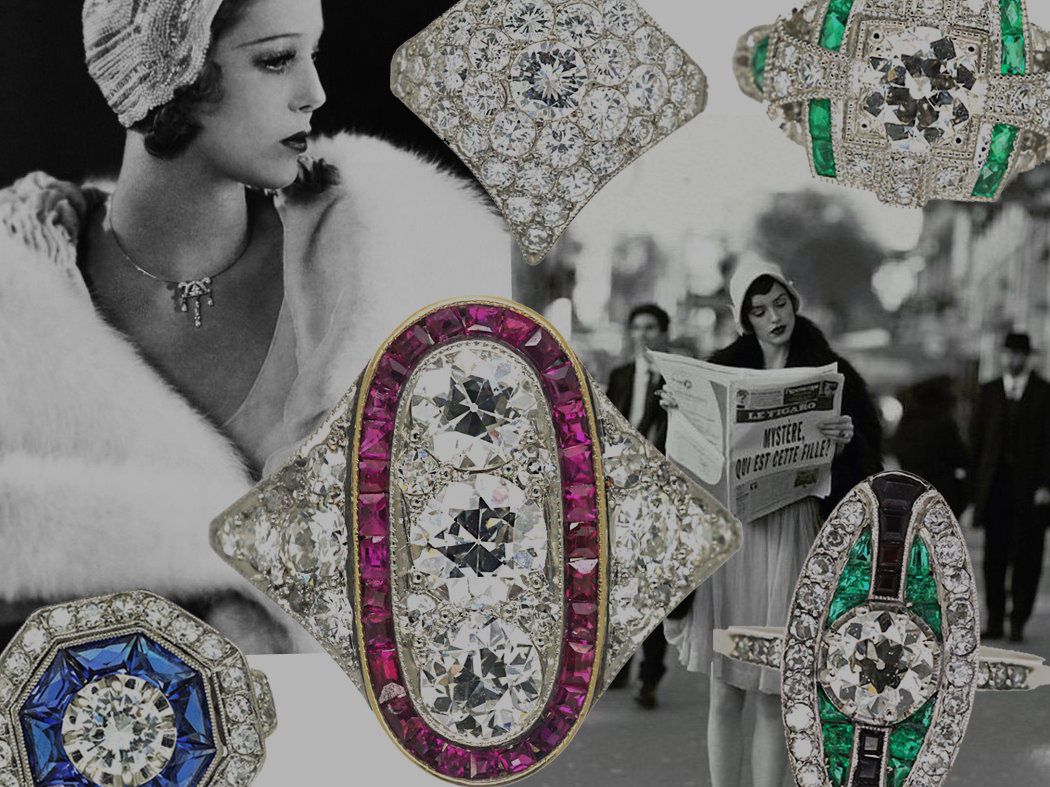
The baguette is the most Art Deco of diamond cuts: a slim, step-cut rectangle that brings clean lines and flashes of light to a ring rather than sparkle. You will rarely see it as the star of an antique ring, but look at the shoulders of almost any 1920s or 1930s diamond ring and there it is, doing quietly brilliant work.
What is a baguette-cut diamond?
A baguette is a long, narrow diamond with parallel step-cut facets, like a staircase seen from above. It has far fewer facets than a brilliant, so it doesn’t sparkle in the same way: instead it gives broad, clear flashes of light, and shows off the clarity of the diamond. Tapered baguettes, narrower at one end, were cut to follow the line of a ring’s shoulders.
A brief history of the baguette
The baguette arrived in the 1920s, as jewellers looked for shapes that suited the geometry of Art Deco design. Its name is French, after the long loaf, and it was used above all as a companion to other stones: set in lines, in channels, or on either side of a centre diamond or coloured stone. Improvements in cutting technology made these small, precise stones practical for the first time.
Pros and cons of a baguette ring
In its favour: a baguette gives a ring clean, modern lines, suits almost any centre stone, and makes the most of a diamond’s clarity. Channel-set baguettes are also very secure.
To bear in mind: baguettes show inclusions more readily than brilliants, their corners can chip if they are exposed, and they give less sparkle. That is why they look their best framing another stone.
Popular styles of baguette ring
Art Deco baguette rings
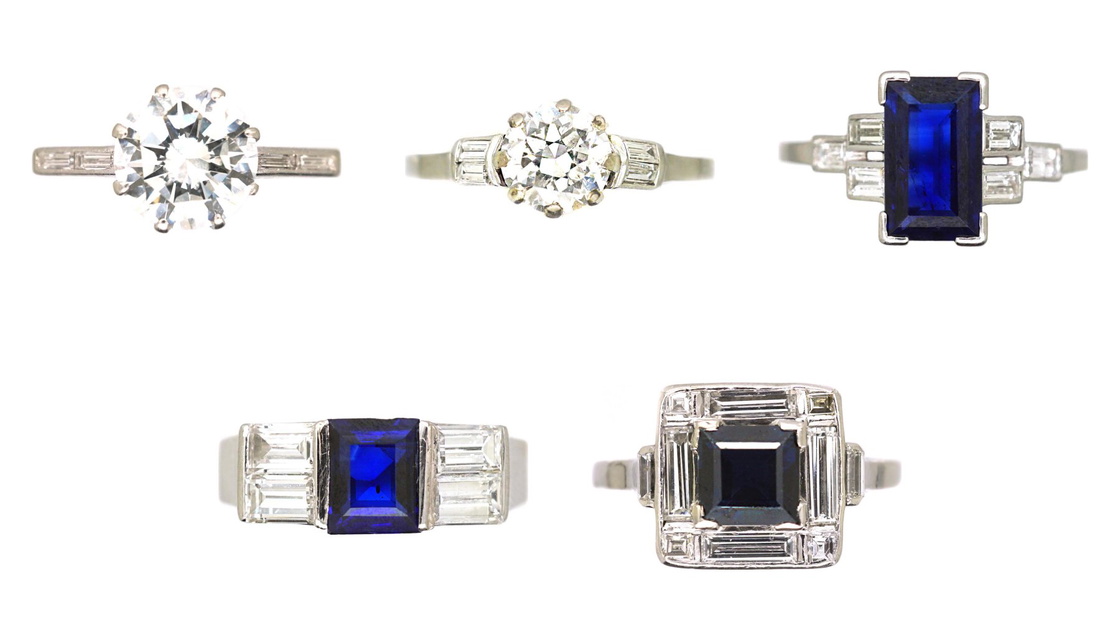
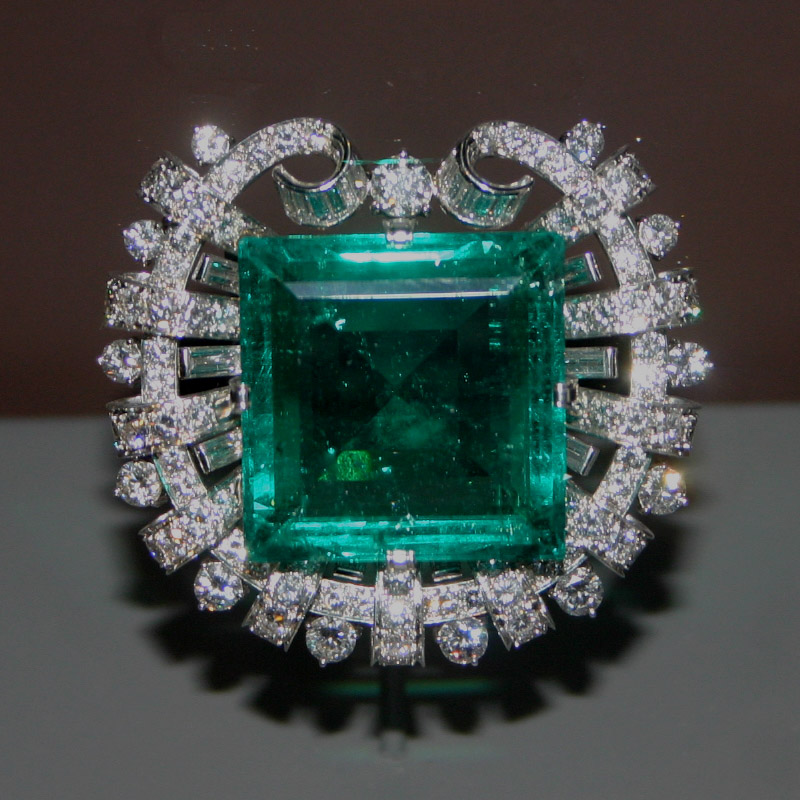
The classic antique baguette ring is Art Deco: a centre diamond or sapphire in platinum, with baguettes on the shoulders or around the stone in a crisp geometric frame, as in this rectangular sapphire ring with baguette diamond shoulders.
Mid-century rings and clusters
In the 1940s and 1950s, jewellers used baguettes more freely, fanning them into sprays and mixing them with round diamonds in larger cluster designs.
Eternity bands
A continuous line of baguettes, channel-set around the finger, makes one of the most elegant eternity rings of all.
Did you know? Marilyn Monroe‘s wedding band for her 2nd marriage was an eternity ring featuring 35 baguette-cut diamonds.
Baguettes on the shoulders of an engagement ring
This is where baguettes do their finest work. A pair of tapered baguettes either side of a solitaire, like this Art Deco solitaire with tapered baguette shoulders, lengthens the ring and makes the centre stone look larger.
Look at the shoulders of an Art Deco ring before you look at the centre stone. Crisp, well-matched baguettes tell you everything about the quality of the whole piece.
Olly Gerrish, AJC Founder
Caring for a baguette ring
Clean baguettes gently with warm soapy water and a soft brush, and have the setting checked every year or two. Their corners are the weak point, so take the ring off for heavy work, and look out for any stone that seems loose in its channel.
What we look for
We look at the matching first: baguettes in a good ring are closely matched in colour and cut, and tapered pairs are mirror images. Then we check the corners for chips, and the settings for wear, since replacing a single baguette to match can be surprisingly difficult.
Our view
For us, baguettes are at their best in Art Deco rings, framing a centre diamond or a coloured stone in platinum. It is one of the most elegant looks in antique jewellery, and still one of the best value. See our Art Deco engagement rings and our guide to antique diamond cuts.