Diamond Engagement Rings
 Sapphire Engagement Rings
 Emerald Engagement Rings
 Ruby Engagement Rings
 Rings
Rings
 Earrings
 Necklaces
 Brooches
 Bracelets & Bangles
 Cufflinks
 Pendants
 Chains
 Tie Pins
 Lockets
 Charms
 Signet Rings
 Seals
Seals
 Curiosities
 UK / £
 USA / $
 AU / $


 Experts since 1975

-
Your Shopping Bag is empty

 Free Worldwide Delivery
 View All
 Diamond
 Sapphire
 Emerald
 Ruby
Ruby





Antique Pearl Engagement Rings: A Buyer’s Guide
Pearls have a quiet elegance that no other gem can match. They are not the most practical choice for an engagement ring, and they need a little looking after, but an antique pearl ring, chosen and worn with care, is soft, romantic and completely individual.
The pros and cons of a pearl engagement ring
In its favour: a pearl has a gentle, luminous beauty, it is the birthstone for June, and antique pearl rings are often very reasonably priced.
To bear in mind: pearls are organic and soft, only 2.5 to 4.5 on the Mohs scale, and they can be damaged by knocks, chemicals, perfume and even the acids in skin over many years. A pearl engagement ring needs more care than a diamond.
The world of pearls
Natural pearls form without human help inside oysters and mussels. For centuries the finest came from the Persian Gulf and the waters off India and Sri Lanka, and they were among the most valuable jewels in the world.
Cultured pearls are grown by placing a bead or piece of tissue in an oyster. Pioneered in Japan and made famous by Kokichi Mikimoto in the early twentieth century, they came onto the market in quantity in the 1920s and transformed the pearl trade.
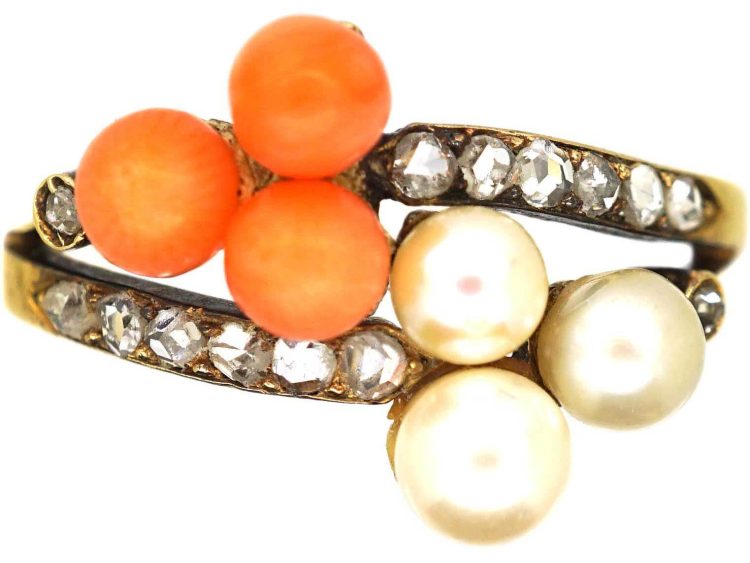
Natural split pearls, small natural pearls cut in half so that they sit flat, are one of the signatures of Victorian and Edwardian jewellery, used in clusters, borders and half hoops.
What to look for
Lustre. A good pearl has a deep, bright glow, with reflections that look sharp rather than chalky.
Surface. Small blemishes are natural, but cracks or peeling are signs of damage.
Natural or cultured. In an antique ring, the difference matters a great deal to value, and for significant pearls a laboratory report is worth having.
Pearls want to be worn. They’re lovelier on the hand than in the box, and a Victorian ring of little split pearls is about the most romantic thing I know.
Olly Gerrish, AJC Founder
Styles of antique pearl ring
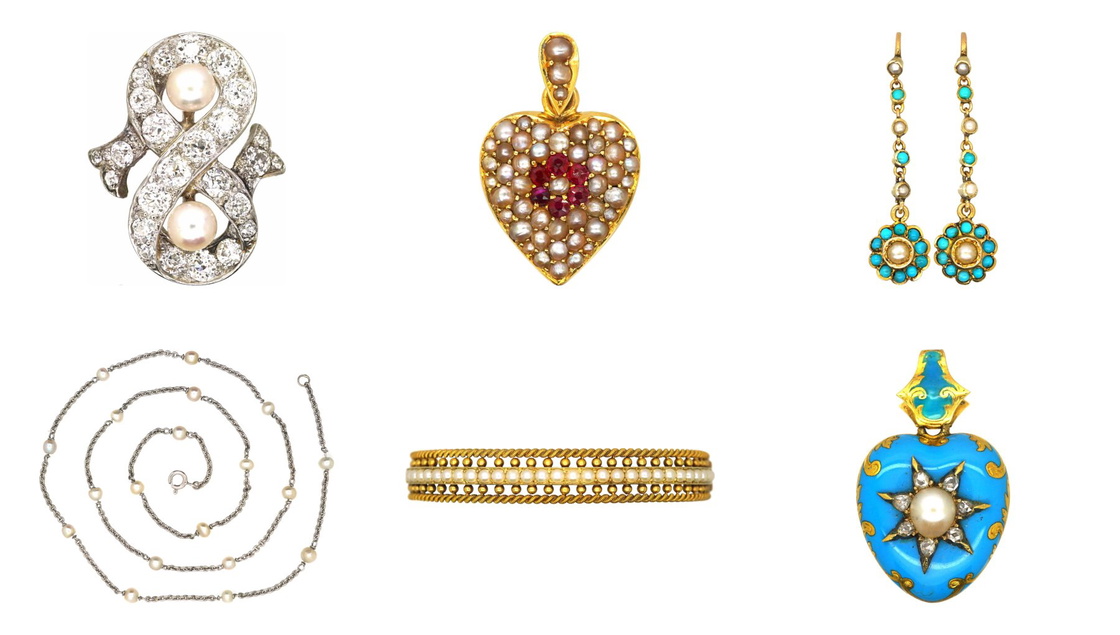
The classic antique pearl rings are Victorian and Edwardian: half hoops and clusters of split pearls, pearls set with diamonds, and rings where a single pearl sits between two stones, like this Victorian figure-of-eight ring with pearls and diamonds. Mixing pearls with diamonds gives both sparkle and softness, and diamonds around a pearl also help protect it.
Caring for a pearl ring
Put your pearl ring on last, after perfume and cream, and take it off first. Wipe it with a soft cloth after wearing, never use an ultrasonic cleaner or chemicals, and remove it for washing, cleaning and sport. Store it separately so harder stones can’t scratch it.
Alternatives to consider
If a pearl ring feels too delicate for daily wear, consider a pearl ring as a dress or anniversary ring, or choose pearl earrings or a pendant for the wedding day instead.
Our view
A Victorian or Edwardian ring of natural split pearls, perhaps mixed with diamonds, is the most beautiful way to wear pearls on the hand. It suits someone who loves soft, romantic jewellery and doesn’t mind a little care. See our antique pearl engagement rings and pearl jewellery.